Career Portal
Staffing agencies that use Bullhorn all get the same plain job board. We built one an agency can restyle to match its own brand, without paying a developer every time it wants a change.
A Bullhorn job board your agency can rebrand without calling a developer.
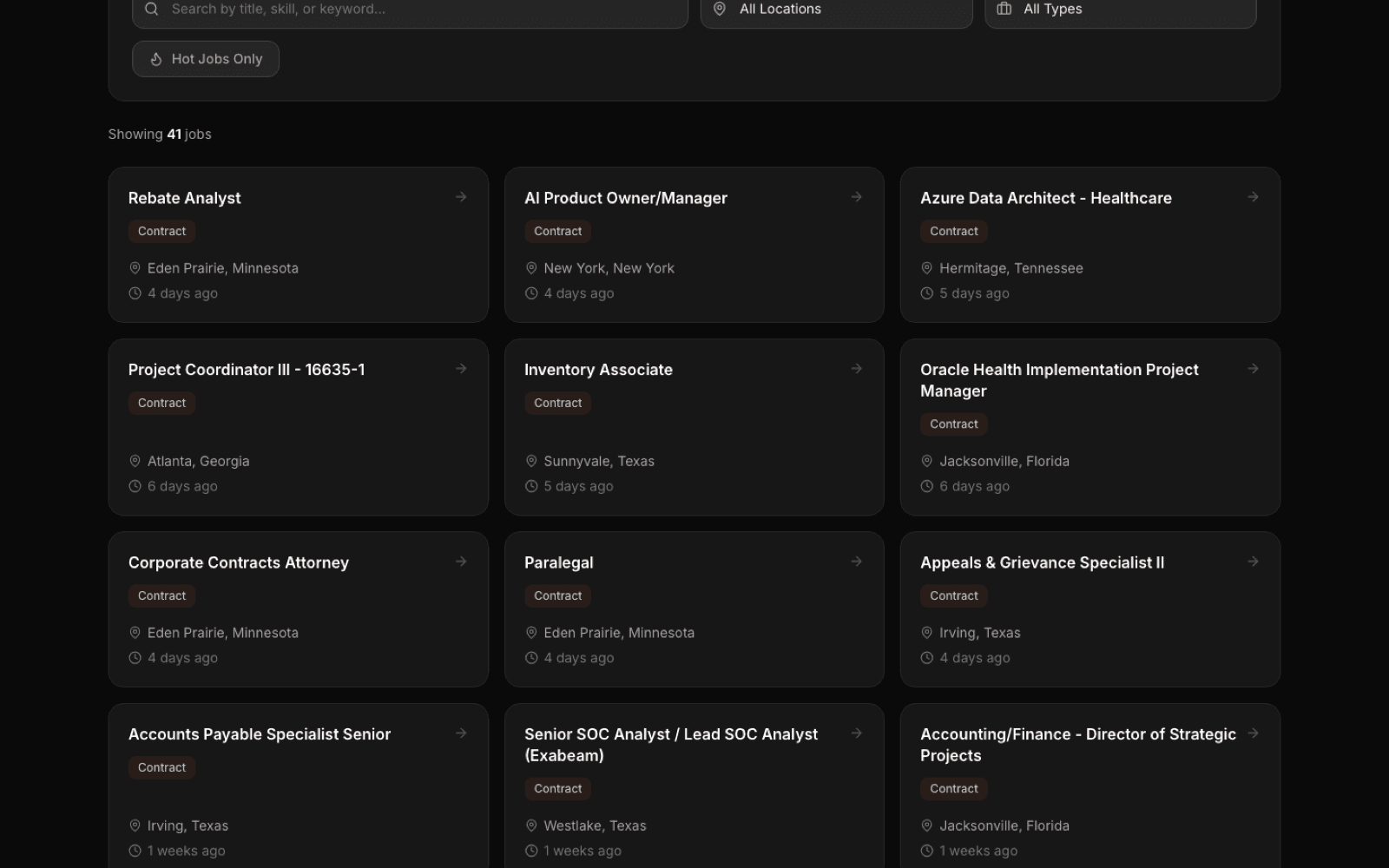
41
Live roles from the Bullhorn API
9
Admin screens your team runs from the browser
3
Environment variables to deploy
0
Databases
Why we built it.
Bullhorn ships an open-source career portal, and every staffing agency running Bullhorn inherits it. It works, but it looks like every other agency's, and changing anything past the logo means forking Angular and owning that fork for good.
So agencies are offered two choices: a portal that looks like everyone else's, or a bespoke build at bespoke prices. Neither suits a firm of sixty people, and that describes most firms.
The decisions we made, and why.
This part gets into the technical detail. If that isn't your thing, the short version is at the top of the page.
We made rebranding a screen, not a fork
Nine admin pages — branding, application fields, features, job display, integrations, and security — write to a config file. Your team changes the name, palette, logo, and which form fields appear, in what order, from the browser. A fork per client is what makes this category expensive, so we designed it out.
We left the database out on purpose
Configuration is a JSON file, and the jobs live in Bullhorn, which is already your system of record. Adding Postgres would have created a second source of truth for data the ATS owns, plus migrations and backups to manage. Deploying takes three environment variables.
We cache by tag as well as by clock
The Bullhorn feed refreshes every 900 seconds, and every fetch is also tagged. Saving a change in the admin clears the cache at once, so your team sees the update straight away instead of a stale board that makes them think the save failed.
What we only learned by testing.
Every item below is a real problem we found by measuring, and each one has a fix behind it. We share them because they tell you more about how we work than the features do.
We audited it with our own instrument, and it found two failures
We ran Loupe against a live instance. Of 30 contrast checks, two were real AA failures, both in the footer at 2.53:1 against the 4.5 required. Everything else held: focus rings on all 15 tab stops, clean layouts at 390 and 1440, full text, a quiet console, LCP 144ms, and CLS 0. We also found 15 of 30 tap targets under 44px. That passes WCAG 2.5.8 but misses our house standard: filter selects at 42px, pagination at 36, and footer links 20px tall. People use a job board on a phone between meetings, so those two pixels matter.
A later rebuild kept only the easy half
A later, cleaner rewrite of this portal dropped the admin panel and kept the job list. We show the original because the admin is the product. On its own, a job list is something every agency already gets for free.
Built with, and still open
- Next.js
- TypeScript
- Tailwind
- Bullhorn Public REST API
- Vercel
- Two AA contrast failures in the footer at 2.53:1, and 15 tap targets under our 44px house standard. We've measured both and haven't fixed them yet.
- We haven't linked the public deployment from this page yet.
- The admin screens are password-protected, so this page shows the portal rather than the panel that is the real product.